Under a typical workflow of manual development and testing, integrating a single spacecraft component can take anywhere from two to six months. To accelerate this process, teams are turning to AI to help automate manual coding for flight software.
However, large language models (LLMs), like Claude, ChatGPT, and Gemini, are probabilistic systems. They produce the next line of code based on statistical likelihood rather than underlying system logic.
In safety-critical aerospace environments, statistical guessing introduces severe risks like non-repeatable outputs, hallucinations, and code that cannot be mathematically proven or audited before deployment. Deterministic systems are the answer to that risk.
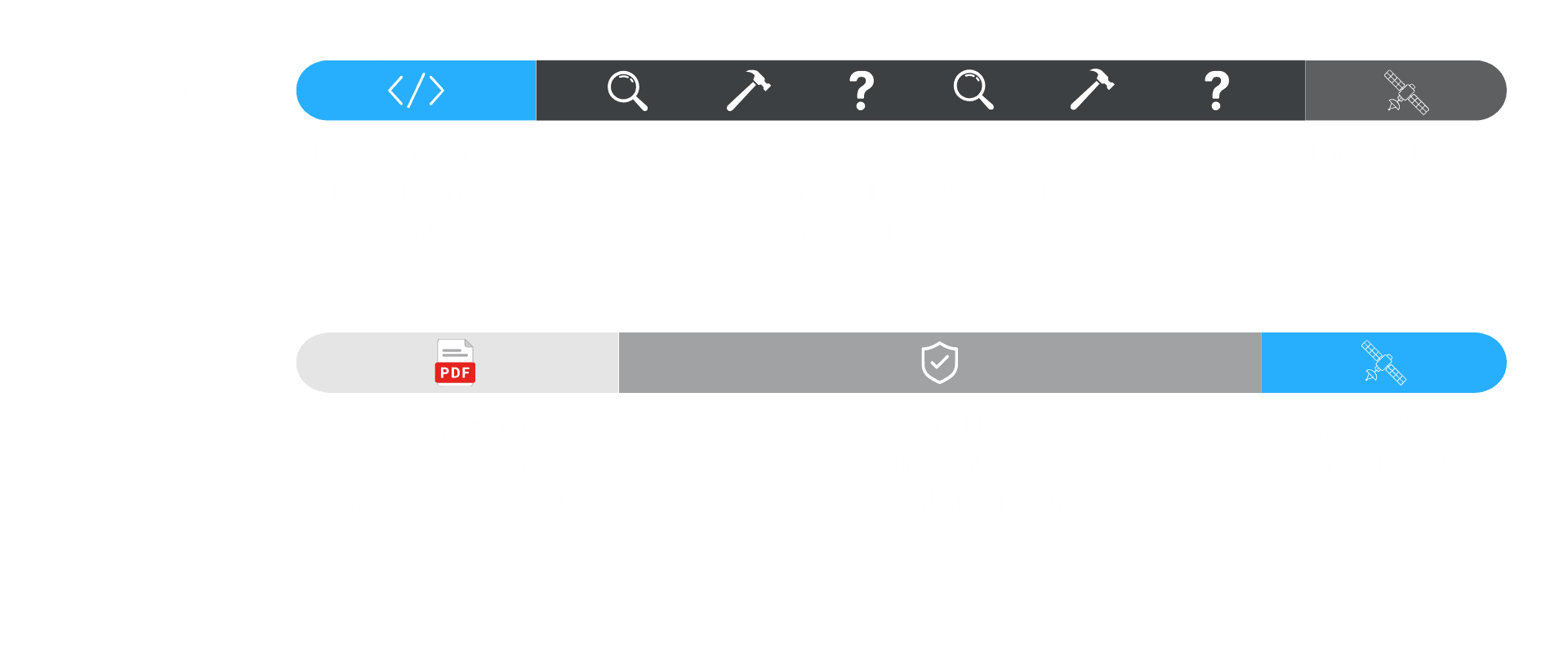
Probabilistic vs Deterministic systems
Probabilistic and deterministic systems generate code through fundamentally different processes, and that difference is what determines how trustworthy the output is for satellite software integration.
Probabilistic code generation predicts each line of code by sampling from a probability distribution learned during training.
Deterministic systems, on the other hand, separate data extraction and code generation. The data extraction can still be handled by AI to parse through unstructured Interface Control Documents (ICDs) and extract command logic, but the actual output source code is generated through a fixed, rule-based, deterministic process.
This means that when you feed the same verified digital model into a deterministic system twice, it will always output identical, mathematically repeatable source code both times.
Probabilistic | Deterministic | |
|---|---|---|
Repeatability | The same prompt can produce different code on different runs. | The same input model always produces the same source code. |
Hallucination | Can generate code referencing functions, register addresses, etc. that do not exist. | Compiles code from the digital model through a rule-based process, so there’s no risk of invented parameters. |
Traceability | Output is not the product of a fixed, auditable process. | Every line of generated code traces back to the digital model and the rule that produced it. |
The hidden costs of probabilistic AI in space
Independent benchmarks found that major probabilistic LLMs produce a hallucinated output in almost 1 in 5 coding task responses. In satellite development, that kind of failure could mean expensive and stressful issues in the cleanroom (or worse, on the launchpad or in orbit).
For this reason, teams that use AI to generate flight software should choose deterministic code generation. Code with hallucinated output carries defects no one knows about, which surface late, when hardware testing is slowest and most expensive to fix.
Probabilistic AI slows down integration teams
Rather than speeding up development, probabilistic code generation actually creates more work in some cases. The difference between an LLM’s initial output and flight-ready code is often too wide. Engineers still need to refactor, review, validate, and manually adapt the code before it can be integrated into a satellite or component’s software.
That review has to be exhaustive because you can’t know in advance which lines of code have been hallucinated. So engineers have to verify every function call, register address, and command sequence against the hardware interface, since a hallucinated call can run without error and still produce the wrong result.
Integration teams are already under intense pressure to meet deadlines, so they have little for extra verification of code that may end up containing hallucinations. Any time saved using probabilistic AI on the initial generation is likely to be spent on the audit and cleanup.
Accelerate AIT workflows with Lynapse™ Studio
Deterministic systems make satellite flight software integration workflows faster while keeping every line of code traceable and verifiable. When an issue does come up, an engineer can find its source and fix it once, without having to worry about reverifying every bit of software the AI generated
Lynapse is built on the deterministic approach and compiles flight-ready code in one to two days per component.
Book a technical deep-dive with our team to see how deterministic code generation can accelerate your satellite software development workflows.